If you run a subscription business, membership business, agency retainer model, SaaS product, gym, studio, or coaching program, you already know the truth: revenue can look fine right up until it doesn't.
One month feels stable. The next month, a few customers cancel, a few invoices slip, a few renewals stall, and suddenly your "healthy" revenue business has a leak. Not dramatic. Just expensive.
This guide breaks down the fundamentals behind the revenue of business — what it is, what drives it, what quietly kills it, and how smart operators grow it without drowning in spreadsheets or dashboard theater.
For lean teams, the challenge usually isn't knowing revenue matters. It's knowing which actions will protect it fastest. That's where a tool like Jetti changes the game: instead of making you dig through messy uploads, disconnected systems, and passive charts, it turns business data into ranked, explainable next steps — so you can spot churn risk, recover at-risk customers, and make better retention decisions without needing a data team.
What Is Revenue in Business?
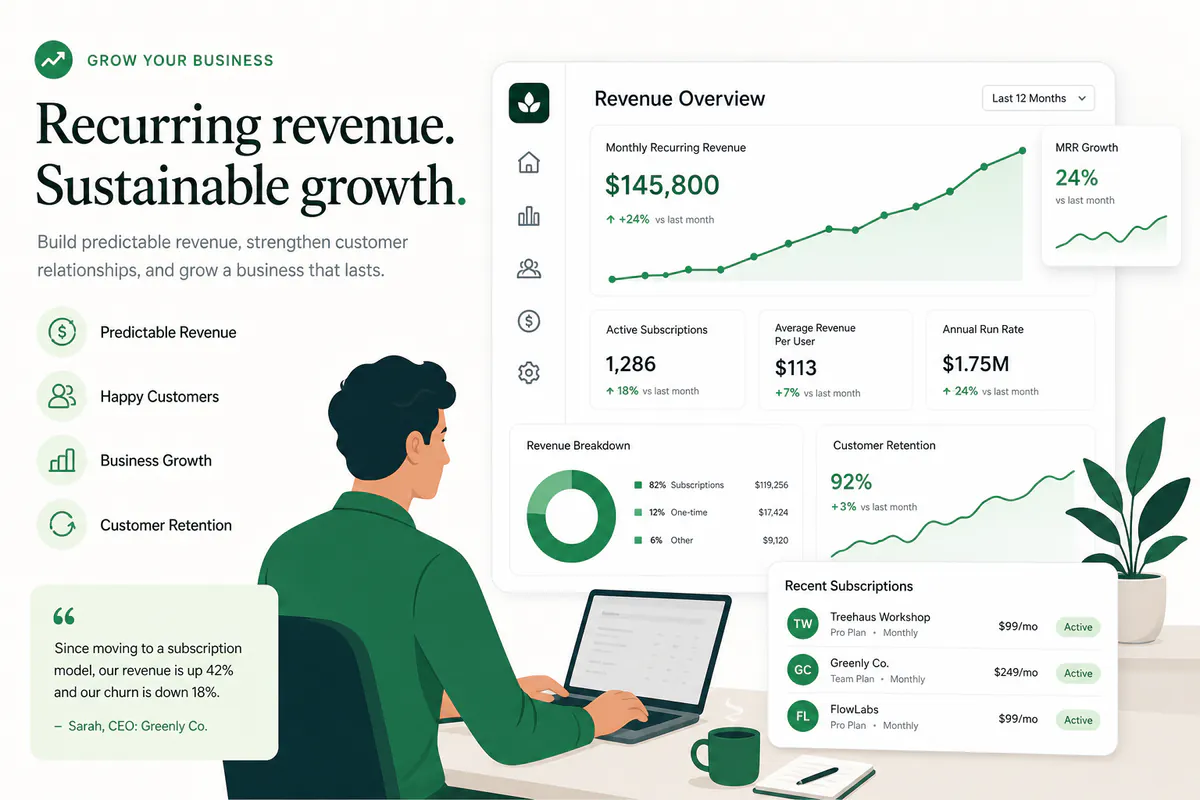
At its simplest, revenue is the total money a business earns from selling products or services before subtracting expenses.
That's the clean definition. But in practice, "revenue business" usually refers to a company designed to generate income consistently from its operating model — not just from one-off sales, but from repeatable, scalable customer demand.
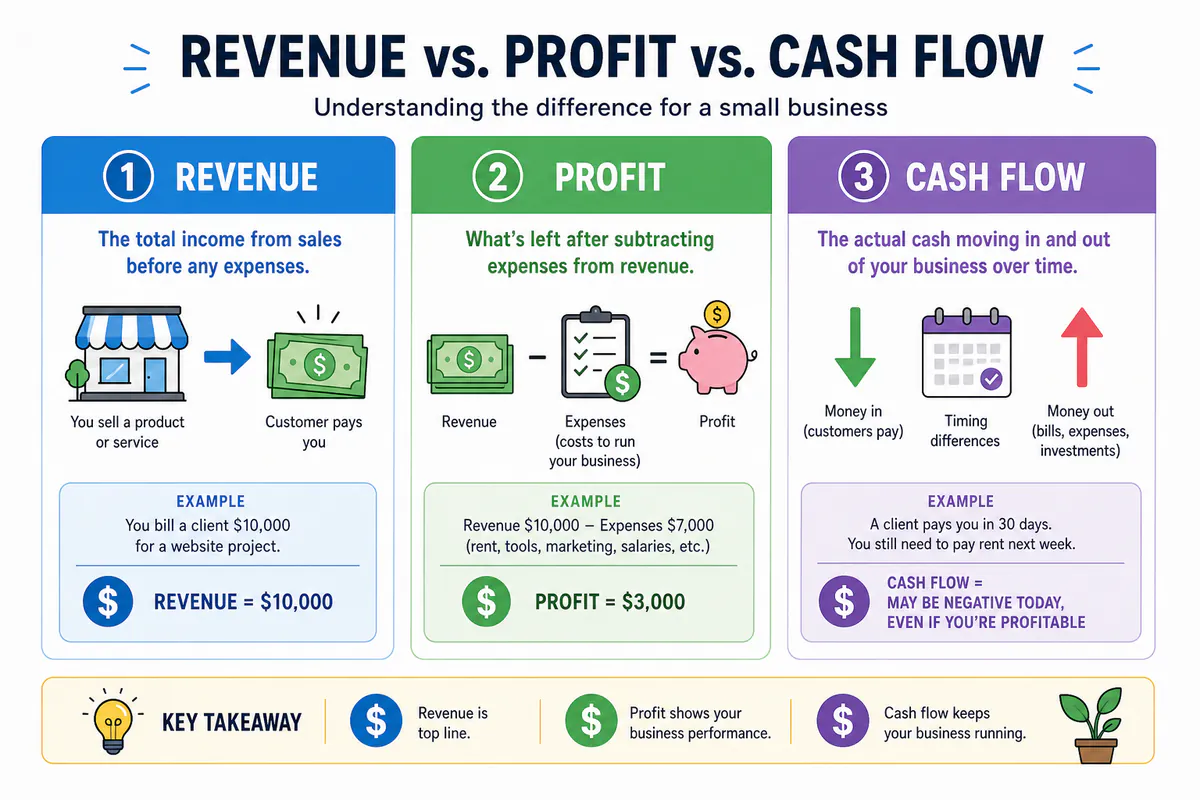
Revenue vs income vs profit
People mix these up constantly, so let's fix that now.
| Term | What it means | What it tells you |
|---|---|---|
| Revenue | Total money brought in from sales or services | Whether demand exists |
| Income | Money left after certain deductions, depending on context | Broader earnings picture |
| Profit | Money left after all business expenses | Whether the business actually makes money |
| Cash flow | Money moving in and out of the business in real time | Whether you can pay bills today |
A business can have strong revenue and weak profit. A business can have good profit on paper and terrible cash flow. A business can even grow revenue while quietly losing customers faster than it replaces them.
That last one is especially common in recurring-revenue models.
Why the Revenue of Business Matters More Than Vanity Metrics
Revenue matters because it is the fuel source for everything else:
- payroll
- marketing
- software
- expansion
- hiring
- debt repayment
- owner compensation
- profit
But the smartest operators don't just track total revenue. They track quality revenue.
What "quality revenue" means
Quality revenue is revenue that is:
- predictable
- repeatable
- profitable
- retainable
- tied to healthy customers
- not overly dependent on one account or one channel
A business doing $80,000/month with stable renewals, low churn, and clear expansion paths is often healthier than one doing $120,000/month with constant cancellations and random one-off wins.
That's one of the biggest content gaps most articles miss: revenue is not just about acquisition. It is deeply shaped by retention.
For recurring-revenue businesses, the real question isn't "How much did we sell?" It's "How much of next month's revenue is actually safe?"
The Core Formula Behind Business Revenue
Most businesses generate revenue through some variation of:
Revenue = Number of customers × Average revenue per customer × Frequency of purchase
For recurring-revenue businesses, the formula gets even more useful:
Recurring Revenue = Active customers × Average monthly contract value × Retention rate
That means your revenue business grows through only a handful of core levers:
- more customers
- higher prices
- better retention
- more expansion or upsells
- better operational efficiency around renewals and follow-up
Simple on paper. Messy in real life.
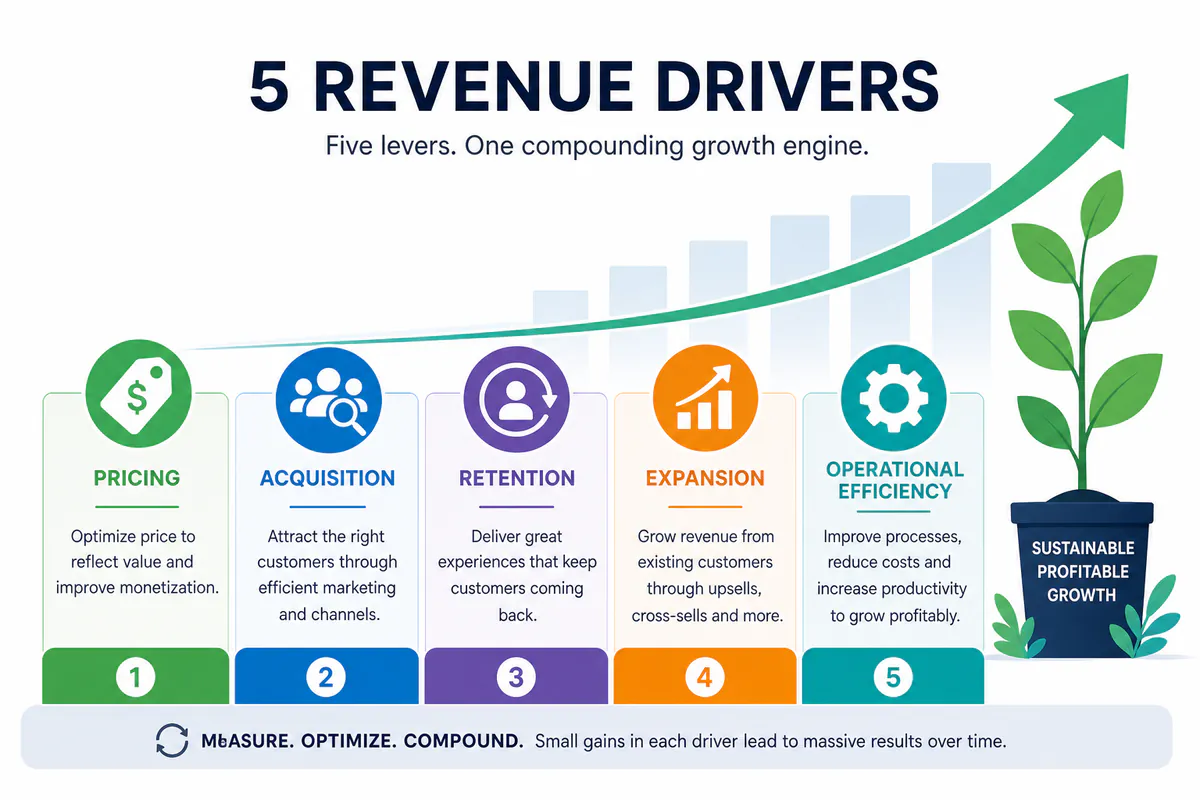
The 5 Biggest Drivers of Business Income
These are the major forces that shape the revenue of business in the real world.
1. Customer acquisition
No customers, no revenue. Brutal but fair.
Acquisition includes all the ways you bring in new buyers or members:
- paid ads
- referrals
- SEO
- outbound sales
- partnerships
- social content
- local visibility
- email funnels
Acquisition drives top-line growth, but it gets overhyped. If your backend retention is weak, new customer volume just papers over churn.
2. Pricing strategy
Pricing is one of the fastest ways to change revenue without increasing workload.
A small increase in average price can create outsized gains, especially when your delivery costs stay roughly the same. But pricing is not just about charging more. It's about:
- positioning
- packaging
- perceived value
- offer structure
- timing
- discount discipline
Bad pricing can kill margin. Great pricing can rescue growth.
3. Customer retention
This is the one too many "revenue business" articles barely touch.
For subscription and recurring businesses, retention is not a support metric. It is a revenue metric.
If you lose fewer customers each month, you protect future income, improve lifetime value, reduce pressure on acquisition, and create compounding growth. Retention is where Jetti shines: it helps small teams identify at-risk customers before they leave, surfaces why they're at risk, and gives ranked action plans plus personalized outreach drafts so you can actually intervene.
4. Expansion revenue
Sometimes the easiest new revenue comes from existing customers.
Expansion includes:
- upsells
- cross-sells
- add-ons
- higher tiers
- annual plan conversions
- additional seats or locations
- premium support or services
If customers already trust you, growing account value is often cheaper than acquiring someone new.
5. Operational efficiency
This sounds boring. It is also wildly profitable.
Revenue gets dragged down by operational mess:
- missed renewals
- inconsistent follow-up
- poor onboarding
- delayed invoicing
- fragmented data
- no clear owner for retention
- reactive outreach
When data lives in spreadsheets, payment exports, and half-maintained CRMs, teams waste hours figuring out who needs attention. Jetti solves that by turning messy uploaded data into usable retention insights quickly — without requiring manual data mapping or a dedicated analyst.
Revenue Business Models: Where Revenue Actually Comes From
Not every revenue business works the same way. Different business models rely on different revenue engines.
Common revenue models
| Business model | How revenue is earned | Example |
|---|---|---|
| Subscription | Monthly or annual recurring fees | SaaS, memberships, communities |
| Usage-based | Charges based on consumption | APIs, utilities, shipping tools |
| Retainer | Ongoing service fee | Agencies, coaches, consultants |
| Transaction-based | Revenue per sale or booking | Ecommerce, marketplaces |
| Hybrid | Recurring base + one-time extras | Studios, service businesses, SaaS with onboarding fees |
For Jetti's ideal users — gyms, studios, SaaS businesses, agencies, and coaching programs — the biggest risk is often not generating first-time revenue. It's failing to protect recurring revenue already on the table.
Revenue vs Profit: The Difference Owners Can't Afford to Ignore
A business owner sees $50,000 in monthly revenue and thinks, "Nice." A sharper operator asks, "How much of that is retained, profitable, and likely to stay?"
Here's the practical difference:
| Scenario | Revenue | Expenses | Profit | What it means |
|---|---|---|---|---|
| Business A | $50,000 | $42,000 | $8,000 | Looks busy, not very healthy |
| Business B | $40,000 | $24,000 | $16,000 | Lower revenue, stronger business |
| Business C | $50,000 | $35,000 | $15,000 | Good top line, decent efficiency |
Revenue is the headline. Profit is the score. Retention determines whether the score repeats next month.
The Hidden Revenue Killers Most Businesses Miss
Competitor content tends to explain revenue definitions well enough. What they usually miss is the stuff that silently erodes revenue.
Revenue leak #1: Churn you discover too late
A customer rarely wakes up and leaves out of nowhere. Usually there are signals:
- missed usage
- failed payments
- reduced engagement
- downgraded behavior
- support frustration
- shorter logins
- attendance drop
- declining purchase cadence
If nobody spots those patterns, revenue disappears quietly.
Jetti is built to catch this before it becomes a cancellation report. It identifies at-risk customers, explains why they're flagged, and helps teams act fast with ranked outreach priorities.
Revenue leak #2: Messy data nobody trusts
A lot of small businesses technically have the data. They just can't use it.
It lives in:
- CSV exports
- billing systems
- attendance sheets
- CRM notes
- spreadsheets named things like
final_v7_REALfinal.xlsx
Not ideal.
Jetti turns messy uploaded data into clean, usable insights quickly, without requiring a data team or painful manual mapping. That means less time reporting and more time saving accounts.
Revenue leak #3: Passive dashboards
Dashboards are fine. Passive dashboards are expensive.
A chart that tells you churn went up last month is not a plan. It's a postmortem.
What lean teams need is:
- who is at risk
- why they are at risk
- who to contact first
- what to say
- which cohort is weakening
- where the best growth opportunity sits
That's why Jetti focuses on decisions, not decoration. It gives ranked, explainable action plans instead of passive reporting.
Revenue leak #4: One-size-fits-all follow-up
If every customer gets the same generic retention email, results will be generic too.
Different customers churn for different reasons. Personalized follow-up performs better, but most small teams don't have time to write it manually. Jetti helps draft outreach messages tied to real customer context, which saves time and increases the odds of a meaningful response.
The Revenue of Business in Recurring Models: Why Retention Beats Hustle
For recurring businesses, revenue growth is often less about selling harder and more about keeping more of what you already earned.
Here's a simple example:
| Metric | Business X | Business Y |
|---|---|---|
| New customers per month | 20 | 20 |
| Average monthly revenue per customer | $200 | $200 |
| Monthly churn | 10% | 4% |
| Result | Constant replacement pressure | Stronger compounding growth |
Both businesses acquire equally. The one with better retention wins.
That's why recurring-revenue teams should track:
- gross revenue retention
- net revenue retention
- churn rate
- renewal rate
- expansion revenue
- average revenue per account
- customer lifetime value
- at-risk cohort behavior
Jetti helps businesses monitor these patterns without forcing them to become mini analytics departments. It detects cohort trends, highlights growth opportunities, and improves over time as it learns how your business behaves.
Practical Examples of Revenue Drivers by Business Type
Gym or fitness studio
Main revenue drivers:
- active memberships
- class attendance consistency
- add-on personal training
- failed payment recovery
- member retention after month 1–3
Big mistake: focusing only on new signups while ignoring members drifting out quietly.
SaaS company
Main revenue drivers:
- free-to-paid conversion
- seat expansion
- annual upgrades
- product adoption
- churn reduction in weak cohorts
Big mistake: tracking signups obsessively while missing product usage signals that predict churn.
Agency or coaching business
Main revenue drivers:
- client retention
- upsells
- package expansion
- referrals
- pricing discipline
Big mistake: treating every client equally instead of prioritizing the highest-risk or highest-opportunity accounts.
Membership or subscription business
Main revenue drivers:
- renewal rates
- engagement frequency
- payment success
- annual plan mix
- win-back campaigns
Big mistake: waiting until cancellation to react.
How to Increase Revenue Without Creating Chaos
You do not need 37 growth hacks. You need a tighter operating system.
1. Raise clarity before raising spend
Before buying more traffic or leads, understand:
- where customers come from
- what they pay
- who stays longest
- where churn clusters
- which segments expand
- which cohorts weaken fast
If you can't answer those, more acquisition just scales confusion.
2. Improve onboarding
A shocking amount of revenue loss begins in the first 30 days.
Customers who don't activate, engage, or see value early are far more likely to leave. Better onboarding improves retention, referrals, and expansion.
3. Prioritize at-risk accounts weekly
This is the kind of thing everyone agrees is important and almost nobody does consistently.
Why? Because it takes too much manual work.
Jetti dramatically cuts that workload by saving significant time on weekly reporting and retention planning. Instead of manually sorting through spreadsheets, you get a ranked list of who needs attention now.
4. Fix failed payments fast
For recurring businesses, failed payments are low-drama revenue killers. Dunning processes, reminders, and quick outreach can recover income without acquiring a single new customer.
5. Build expansion offers intentionally
Don't wait for upsells to happen by accident. Create structured paths:
- standard to premium
- monthly to annual
- solo to team
- base plan to add-ons
Expansion revenue is often the cleanest growth lever.
6. Review pricing regularly
If you haven't reviewed pricing in a year, you may be undercharging. If you discount constantly, you probably are.
A Smarter Framework for Revenue Decisions
Here's a simple framework owners can use before making any major revenue move.
| Question | Why it matters |
|---|---|
| Will this increase revenue fast or just look busy? | Avoid vanity projects |
| Does this improve retention or only acquisition? | Protect future income |
| Is this profitable after delivery costs? | Preserve margin |
| Can the team operationally support it? | Prevent churn from poor service |
| Can we measure the result clearly? | Avoid guessing |
This is where AI becomes genuinely useful — not in writing fluffy summaries, but in helping operators make better calls faster.
Jetti's AI assistant can answer member-level questions, draft outreach, detect revenue patterns, and help prioritize action based on explainable signals. That's a lot more useful than staring at a chart and pretending clarity will arrive on its own.
Revenue Reporting: What Small Businesses Should Actually Track
You do not need a bloated KPI graveyard. You need the handful of metrics that tell the truth.
Must-track revenue metrics
- total revenue
- monthly recurring revenue
- average revenue per customer
- churn rate
- renewal rate
- failed payment rate
- expansion revenue
- net revenue retention
- lifetime value
- cohort performance
Best practice for lean teams
Track metrics at three levels:
| Level | What to track | Why |
|---|---|---|
| Business level | Total revenue, MRR, churn | Overall health |
| Segment level | Cohorts, plan types, acquisition channels | Find patterns |
| Customer level | Risk flags, engagement, billing issues | Enable action |
This layered view is where Jetti is particularly strong. It doesn't just summarize the business; it helps you move from high-level patterns to specific customers who need intervention.
Why Privacy Matters in Revenue Intelligence
When you're handling customer and payment data, privacy is not optional.
A lot of lean teams want AI help but hesitate because they don't want sensitive information flying around unsecured tools. Fair concern.
Jetti's positioning is especially strong here: it prioritizes privacy with masked names, encryption, and privacy-by-design data handling. That makes it practical for businesses that want real AI-powered revenue intelligence without being reckless with customer data.
Two Revenue Truths Worth Remembering
"82% of small business failures are due to poor cash flow management or a lack of understanding of cash flow." — Preferred CFO
That's the blunt reminder: revenue alone is not enough if the business can't understand what's happening underneath it.
"Revenue is total money from core business activities before expenses are deducted." — Investopedia
Also simple, also important. Revenue is the start of the story — not the ending.
Common Mistakes Businesses Make With Revenue
Mistake 1: Treating revenue as proof of health
Top-line growth can hide weak retention, bad margins, and rising acquisition costs.
Mistake 2: Measuring backward instead of forward
Historical reports matter, but they do not prevent churn. Predictive action does.
Mistake 3: Not knowing which customers matter most
All customers generate revenue. Not all customers carry equal risk or equal upside.
Mistake 4: Assuming data cleanup requires analysts
It shouldn't. Modern tools should handle messy inputs and produce useful outputs quickly.
Mistake 5: Waiting too long to act
The best time to save a customer is before they mentally leave, not after they click cancel.
Final Verdict: What Really Drives Business Income
The revenue of business is driven by a few core levers: customer acquisition, pricing, retention, expansion, and operational efficiency.
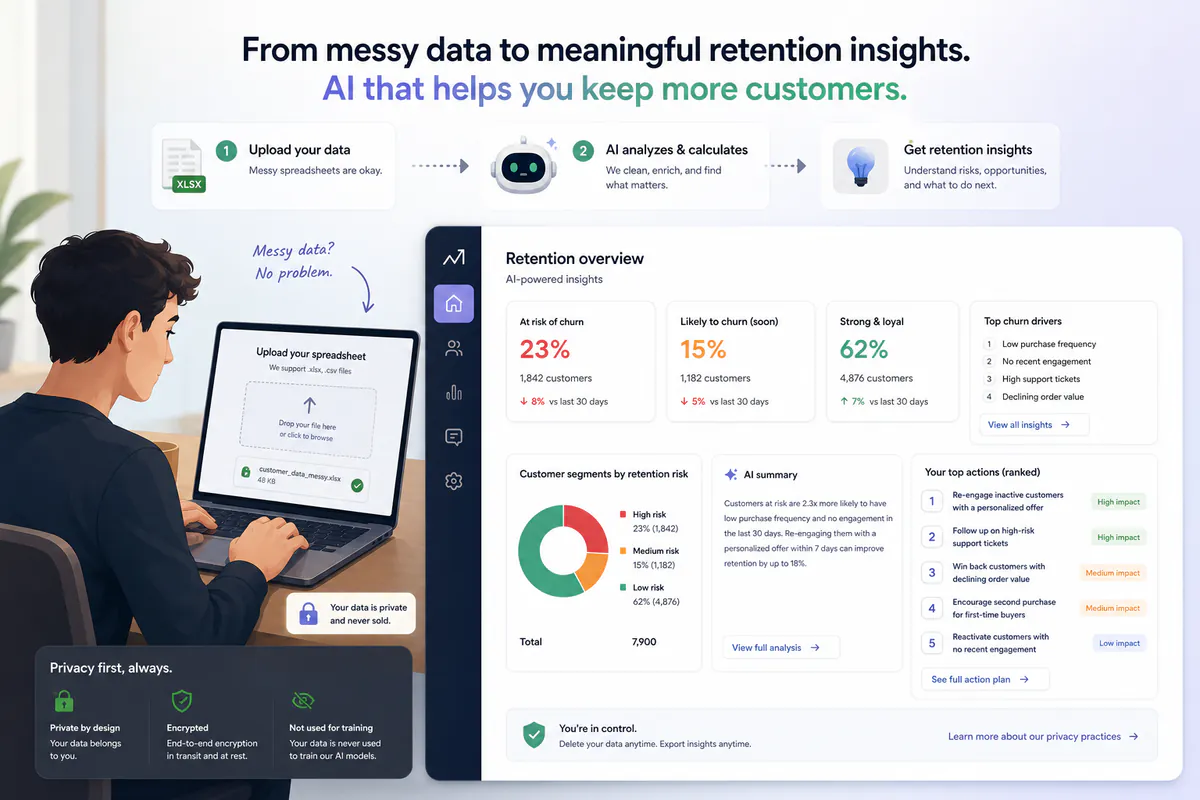
But in recurring-revenue businesses, the biggest unlock is often not "more leads." It's better visibility into which customers are at risk, which cohorts are weakening, and what action will actually protect next month's income.
That's the difference between generic reporting and real revenue intelligence.
If your team is still stitching together spreadsheets, guessing who might churn, and spending hours every week producing reports nobody acts on, Jetti is built for exactly that mess. It helps you:
- identify at-risk customers before they leave
- turn messy uploaded data into usable insights quickly
- save major time on reporting and retention planning
- get ranked, explainable action plans instead of passive dashboards
- draft personalized outreach for follow-up
- detect cohort patterns and growth opportunities
- work without a data team or manual mapping
- improve over time as it learns your business
- get strong ROI compared with hiring staff
- protect privacy with masked names, encryption, and privacy-by-design handling
If you want a revenue business that is not just growing, but staying grown, try Jetti.
FAQ
The five core drivers are customer acquisition, pricing, retention, expansion revenue, and operational efficiency. Together, they shape how much revenue a business generates and how reliably that revenue holds up over time.
Revenue is the total money a business brings in before expenses, while income usually refers to what remains after certain costs are deducted. In plain English: revenue is the top line, and income is closer to what the business actually keeps.
Four common business income sources are product sales, service fees, recurring subscriptions or retainers, and expansion revenue such as upsells or add-ons. The right mix depends on your business model and customer behavior.
You can increase revenue by getting more customers, raising pricing, improving retention, and growing average customer value through upsells or add-ons. For recurring-revenue businesses, retention is often the fastest and most profitable lever.
A practical seven-pillar view includes strategy, sales, marketing, operations, finance, customer retention, and people. Revenue improves when these pillars work together instead of operating in silos.
The 3 3 3 rule in sales can mean different things depending on the team, but it generally refers to a simple outreach or follow-up structure built around three actions, three touchpoints, or three days. The bigger idea is consistency: revenue grows when sales and retention follow-up happen on a repeatable system, not random bursts of effort.