If you run a recurring-revenue business, growth usually looks great from the outside right up until churn starts quietly eating your lunch.
One spreadsheet tracks payments. Another tracks customers. Someone on the team "kind of knows" who might cancel. Weekly reporting turns into a scavenger hunt. Outreach happens late, if at all. And somehow the business is expected to grow with confidence through all that chaos.
That's where the idea of all & one becomes genuinely useful.
In plain English, all & one means pulling all the messy signals that matter — customer behavior, payment history, retention trends, cohort patterns, and outreach priorities — into one clear growth system. Not more dashboards. Not more tabs. One operating view that helps you protect recurring revenue and spot growth opportunities before they slip away.
For lean teams, this is the difference between reactive scrambling and smart execution.
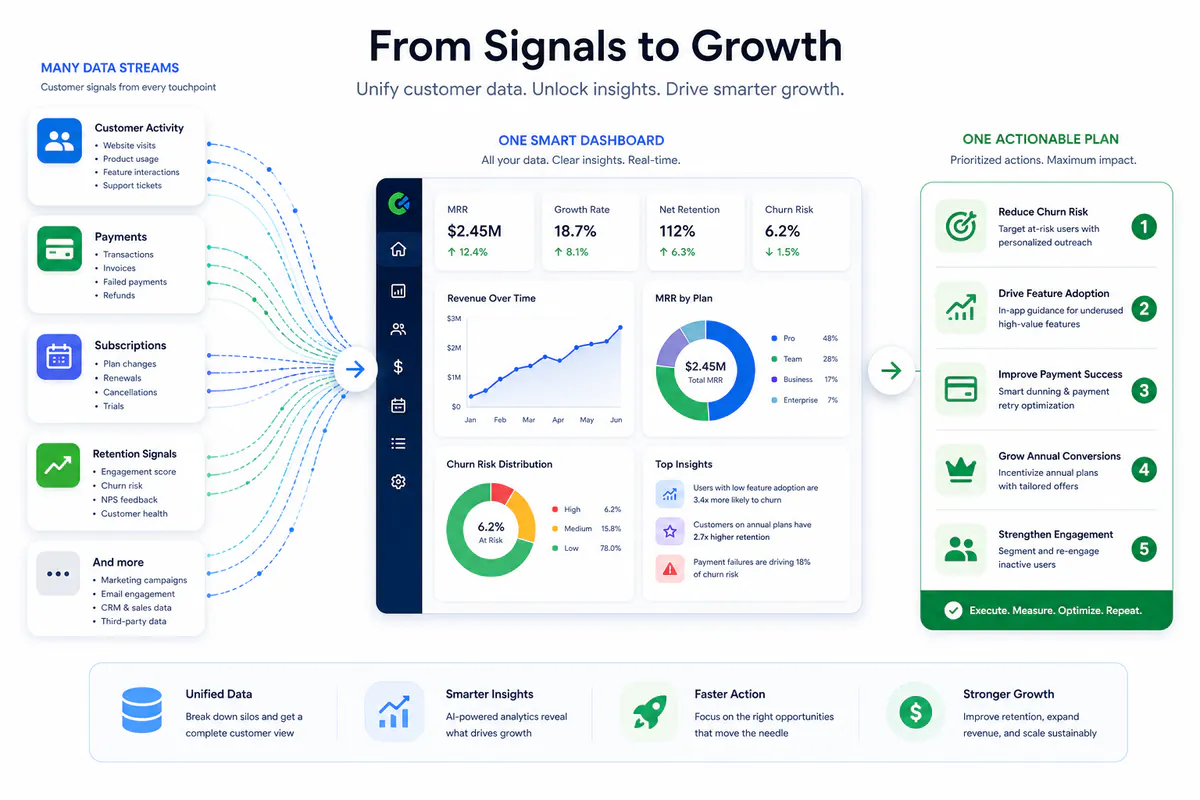
What "all & one" actually means in a business growth strategy
Most growth advice still treats departments and systems like separate planets.
Marketing wants lead volume. Finance wants clean payment data. Customer success wants renewal visibility. Ops wants fewer fire drills. Founders want growth without hiring a full analytics team.
The all & one approach says: stop optimizing in fragments.
Instead, unify the signals that actually predict recurring revenue health:
- Customer activity
- Billing and payment behavior
- Retention and churn risk
- Cohort trends
- Expansion and upsell opportunities
- Priority outreach actions
That matters because recurring revenue businesses do not fail from a lack of metrics. They fail from a lack of clarity.
A business can have plenty of data and still miss the obvious questions:
- Who is most likely to churn this week?
- Which failed payments need action first?
- Which cohort is quietly underperforming?
- Which customers are good candidates for upsell or reactivation?
- What should the team do next, in order?
That's the real content gap many competitor articles gloss over. They talk about growth strategy at the 30,000-foot level. But small businesses need a version that works on Tuesday morning with messy exports, limited staff, and very little time.
Why fragmented data kills recurring revenue growth
Growth gets harder when signals are split across tools.
Here's what fragmentation usually looks like:
| Problem | What it looks like in real life | Business impact |
|---|---|---|
| Customer data is incomplete | Notes in one tool, billing in another, behavior in a spreadsheet | No one sees the full customer story |
| Payment issues are buried | Failed charges sit in reports no one checks fast enough | Preventable revenue loss |
| Retention work is reactive | Team reaches out after cancellation signals become obvious | Lower save rates |
| Reporting takes too long | Founders spend hours stitching exports together weekly | Less time for action |
| Growth opportunities stay hidden | Cohort changes and expansion patterns go unnoticed | Slower revenue growth |
In other words, you can't run a sharp retention engine on scattered information.
You need one view that turns disconnected data into decisions.
The four pillars of an all & one growth model
A stronger business growth strategy for recurring revenue comes down to four pillars.
1. Unified customer intelligence
You need a single view of the customer, not a pile of disconnected clues.
This includes:
- Join date or start date
- Plan, package, or membership level
- Payment consistency
- Usage or engagement patterns
- Account changes over time
- Retention risk signals
When these sit in one place, you can stop guessing and start prioritizing.
2. Revenue-aware retention
Not all churn risk is equal.
A healthy strategy doesn't just identify "at-risk customers." It identifies:
- Who is at risk
- How much revenue is exposed
- Why they are slipping
- What action should happen next
That's a much smarter way to allocate limited time. A lean team should not spend equal effort on every account. It should focus where the revenue risk or growth upside is highest.
3. Explainable action plans
Most dashboards are passive. They tell you what happened and then politely leave you alone with the problem.
A practical all & one model should produce:
- Ranked outreach lists
- Clear churn drivers
- Cohort-level patterns
- Suggested next steps
- Drafted follow-up messages
This is where Jetti fits naturally. Instead of flooding small businesses with charts for the sake of charts, Jetti turns uploaded customer and payment data into ranked, explainable action plans. That means business owners spend less time decoding reports and more time saving revenue.
4. Fast execution without a data team
This part is underrated.
A lot of "smart growth" advice quietly assumes you have analysts, RevOps support, implementation consultants, and pristine CRM data.
Most small recurring-revenue businesses have none of that.
They have:
- messy CSVs
- inconsistent field names
- multiple systems
- too little time
- no appetite for a six-month integration project
An all & one growth strategy only works if it's usable in the real world. Jetti is designed for exactly that scenario: upload the messy data, let the system organize it, and get useful retention and growth insights without manual data mapping gymnastics.
Growth strategy vs. growth theater
Let's be honest: plenty of businesses are doing growth theater.
They add more tools. More dashboards. More reporting. More meetings. Yet retention does not improve.
Why? Because visibility is not the same as action.
A smarter strategy asks a different set of questions:
| Growth theater | Smarter growth |
|---|---|
| How many dashboards do we have? | Do we know who needs attention today? |
| Can we track every metric? | Can we protect revenue with the team we have? |
| Did we build a report? | Did we change an outcome? |
| Do we have more data? | Do we have clearer next steps? |
This is one of the biggest strategic gaps in competitor content. They talk a lot about automation and AI in broad terms, but not enough about decision quality.
For lean operators, the value of AI is not "wow, that's futuristic." It's:
- finding churn risk before the cancellation
- cleaning ugly data fast
- drafting personalized outreach
- surfacing cohort issues early
- saving hours every week on reporting and prioritization
That's the difference between shiny software and useful software.
Why AI belongs in your growth strategy now, not "later"
AI is not magic. But it is extremely good at removing repetitive analysis and surfacing patterns humans miss.
For recurring-revenue businesses, that's a big deal.
"Approximately 74% of small businesses using AI report increased productivity." — QuickBooks
That productivity boost matters because small businesses don't usually have a retention department. They have one founder, one operator, maybe a customer success lead, and a lot of tabs open.
AI earns its keep when it helps that small team do the work of a much larger one.
Where AI adds practical value
Cleaning and organizing messy uploaded data
If your source data is inconsistent, late, or incomplete, your reporting is automatically weaker. AI can normalize and structure that information fast, which means less manual prep and quicker insight.
Detecting churn risk early
Patterns often show up before a customer actually leaves: missed payments, lower engagement, downgraded usage, delayed responses, or subtle cohort drift. AI can catch those patterns at scale.
Prioritizing action
A good system doesn't just say "these 40 customers might churn." It ranks them based on likely impact and urgency.
Drafting personalized follow-up
Execution is where many teams stall. Jetti helps by drafting personalized outreach messages, so the team can move from insight to action without staring at a blank email composer for half the afternoon.
Learning over time
A strong recurring revenue platform should improve as it learns the business: what patterns precede churn, which interventions work, and where expansion opportunities tend to appear.
Retention is not a side metric. It is the growth engine.
Acquisition gets the applause. Retention pays the bills.
That's especially true for gyms, studios, SaaS businesses, agencies, coaching programs, and membership models where small monthly losses compound into serious annual damage.
"Increasing customer retention rates by just 5% can boost profits by as much as 95%." — Bain & Company
That stat is dramatic because retention has a multiplier effect:
- You preserve existing revenue
- You reduce replacement pressure
- You improve forecasting
- You increase lifetime value
- You create more room for efficient growth
So if your growth strategy still treats retention as a support function instead of a core operating system, it's overdue for a rethink.
How small businesses can apply the all & one model without overcomplicating everything
You do not need a giant transformation plan. You need a cleaner way to answer the right questions.
Step 1: Pull all the revenue-relevant inputs together
Start with the essentials:
- customer list
- subscription or membership records
- invoices or payment logs
- churn or cancellation history
- engagement or usage signals
- renewal or plan-change data
The goal is not perfection. The goal is enough signal to see what's happening.
Step 2: Find the customers who need attention first
Not eventually. First.
Look for:
- recent failed payments
- declining usage
- shortened tenure patterns
- high-value accounts with weak engagement
- cohorts with worsening retention
Jetti is built for this exact step. It helps identify at-risk customers before they leave and gives you an explainable reason why they've been flagged.
Step 3: Turn analysis into a ranked action list
This is where many teams fail. They generate insight and then stop.
A good weekly workflow should output:
- who to contact
- why they matter
- what to say
- what to offer or ask
- what signal to watch next
That's vastly more useful than a generic retention dashboard no one checks after Wednesday.
Step 4: Track patterns by cohort, not just by individual account
If one person churns, that might be random. If one cohort starts slipping, that's strategy.
Cohort analysis can reveal:
- weak onboarding groups
- customers from a specific channel with lower retention
- plan types with higher downgrade rates
- locations or service lines with payment instability
- seasonal patterns affecting renewals
Jetti helps detect those cohort patterns and growth opportunities without requiring a data team to build the logic from scratch.
Step 5: Build a weekly retention rhythm
Simple wins here.
A weekly recurring process could look like this:
| Day | Focus | Output |
|---|---|---|
| Monday | Review at-risk customers | Ranked action list |
| Tuesday | Send outreach | Personalized emails or calls |
| Wednesday | Review failed payments | Recovery actions |
| Thursday | Check cohort shifts | Pattern notes and experiments |
| Friday | Review saves, churn, and growth opportunities | Next week's priorities |
That's an operating cadence. And operating cadence is what turns strategy into revenue protection.
What the best growth strategies include that generic advice misses
Competitor articles often mention market penetration, product development, diversification, partnerships, and automation. All good. All true.
But for recurring-revenue businesses, the strongest growth strategies also include these less glamorous, far more profitable habits:
Revenue visibility by customer
Not just topline growth. You need account-level revenue context.
Early-warning systems
The best time to save a customer is before they are mentally gone.
Actionable segmentation
Segments should tell you what to do, not just how to label people.
Lightweight execution
If a process needs five people to maintain it, many small businesses will abandon it.
Privacy-first handling of customer data
This matters more than ever. Jetti prioritizes privacy with masked names, encryption, and privacy-by-design handling, which makes it easier to work with sensitive customer data responsibly.
ROI that makes small-business sense
Hiring analysts, ops staff, and retention specialists is expensive. If a platform can recover revenue, save hours each week, and improve decision quality at a fraction of that cost, the ROI becomes pretty compelling pretty fast.
Common mistakes businesses make when trying to grow recurring revenue
Mistake 1: Chasing acquisition while ignoring preventable churn
Pouring budget into new customers while existing ones slip away is like filling a bucket with a hole in it. Very energetic. Not especially effective.
Mistake 2: Measuring everything except what drives action
Vanity metrics are comfortable. Prioritized intervention lists are useful.
Mistake 3: Assuming data must be perfect before it can be useful
Waiting for ideal data often means waiting forever. Smart platforms can work with imperfect inputs and still produce strong guidance.
Mistake 4: Treating retention as manual detective work
If the founder has to personally inspect every account every week, the process won't scale.
Mistake 5: Using tools that explain the past but not the next move
Historical analytics are helpful. But recurring-revenue businesses need decision support more than digital wallpaper.
A practical all & one framework for lean teams
Here's a simple framework you can actually use.
All signals in
Bring together customer, payment, churn, and engagement data.
One truth out
Create one reliable picture of account health and revenue exposure.
All priorities ranked
Focus the team on the highest-impact customers and cohorts first.
One next move
Assign a concrete, explainable action for each risk or opportunity.
All learning captured
Track what saves customers, what fails, and what patterns keep repeating.
This is basically the operating logic behind Jetti: turning messy recurring-revenue data into usable insights quickly, then converting those insights into ranked, explainable action plans the team can act on immediately.
What to look for in a recurring revenue intelligence platform
If you're evaluating tools, avoid getting distracted by feature lists with 90 bullet points and very little practical payoff.
Look for this instead:
| What to look for | Why it matters |
|---|---|
| Easy data upload | You need fast setup, not a long implementation project |
| Flexible handling of messy schemas | Real small-business data is rarely clean |
| Churn risk detection | You need early signals, not post-mortems |
| Explainable recommendations | Teams trust actions more when they understand the "why" |
| Ranked priorities | Limited time should go to highest-impact accounts |
| Cohort insights | Growth opportunities often appear in groups, not just individuals |
| Outreach support | Acting quickly is easier when messages are drafted for you |
| Privacy-by-design | Customer data needs secure, responsible handling |
| Strong ROI | The tool should cost less than the time and revenue it saves |
That checklist is also why Jetti stands out for lean recurring-revenue businesses. It is designed to work without requiring a data team, manual mapping marathon, or endless dashboard interpretation.
Final verdict: smarter growth means all signals, one decision system
The strongest business growth strategy for recurring-revenue businesses is not about adding more complexity. It's about reducing it.
All & one is a smart way to think about growth because it aligns how the business actually works:
- all your key signals in one place
- one clear view of churn risk and growth potential
- all priorities ranked by impact
- one practical next step for the team
If you're still managing retention through spreadsheets, disconnected systems, and intuition-heavy follow-up, you are not short on effort. You're short on usable clarity.
Jetti fixes that.
It helps you identify at-risk customers before they leave, turns messy uploaded data into usable insights quickly, saves serious time on weekly reporting, delivers ranked and explainable action plans, drafts personalized outreach, highlights cohort patterns and growth opportunities, and does it all without needing a data team. Add privacy-first handling and a much better ROI than hiring extra staff, and it becomes a very practical growth move.
If you want a simpler, sharper way to protect recurring revenue and grow with confidence, try Jetti.
Because growth gets a lot easier when all the right signals lead to one smart action system.
FAQ
The classic four are market penetration, product development, market expansion, and diversification. For recurring-revenue businesses, those strategies work best when paired with strong retention systems that protect existing revenue while you grow.
The four practical steps are identify the customer, understand their behavior, personalize the message, and take timely action. In recurring revenue, that often means spotting churn risk early and sending relevant outreach before the customer leaves.
The 1% rule usually means making small, consistent improvements that compound over time. In retention-focused businesses, even modest gains in payment recovery, outreach timing, or customer retention can create a meaningful revenue lift.
A common model includes existence, survival, stability, growth, expansion, maturity, and renewal or reinvention. Recurring-revenue businesses move through these stages more smoothly when they unify customer, payment, and retention insights instead of managing them in silos.
The meaning can vary, but it often refers to a simple cadence for timely follow-up, focused outreach, and clear prioritization. The core idea fits this article well: don't overwhelm the team, just make sure the highest-value actions happen quickly and consistently.
The 5 C's are commonly Company, Customers, Competitors, Collaborators, and Context. In a recurring-revenue model, customer and context data become especially important because churn, payment behavior, and cohort trends directly shape growth outcomes.